
Do MoE Experts Need Different Learning Rates?
Why Moonlet's old 15x expert-LR rule overshoots in bf16 AdamW
There is a durable MoE superstition: experts only see a thin slice of tokens, so they must need a much larger learning rate than the dense path. Moonlet inherited that superstition in the loudest possible form: lr_expert = 15x * lr_dense.
It sounds plausible because a clean counting argument really does say sparse routing should attenuate raw expert gradients. The trap is that the counting argument lives at the raw gradient, while training happens at the applied optimizer step. If AdamW cancels most of the attenuation before the update, then a large expert-LR multiplier is not a correction. It is an overcorrection.
This post makes that distinction earn its keep on the actual Moonlet contract. The result is narrower than the old superstition and stronger than a tuning anecdote: in Moonlet bf16 with AdamW, lr_expert = lr_dense is the right baseline, and 15x is wrong.
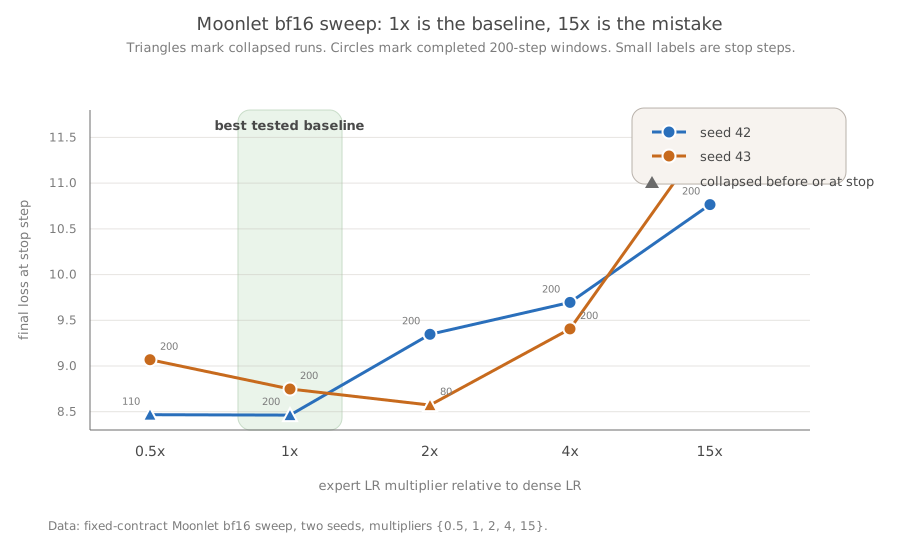
bf16 lane, 1x is the best baseline. Smaller undercooks, larger multipliers overcook, and 15x is the loud wrong answer Moonlet used to carry.The rest of the paper explains why that happens and where the boundary still moves.
The Moonlet contract
We study the actual nmoe Moonlet contract.
| Field | Value |
|---|---|
| Config | configs/moonlet.toml |
| Architecture | dim = 2048, n_layers = 12 |
| Dense FFN width | inter_dim = 11264 |
| Routed expert width | moe_inter_dim = 1408 |
| Routed experts | E = 64, K = 6, n_shared_experts = 2 |
| Base LR | lr_dense = lr_router = 3e-3 |
| Main sweep | lr_expert = m * 3e-3, m in {0.5, 1, 2, 4, 15} |
| BF16 lane | dtype = bf16, expert_opt = auto -> AdamW |
| NVFP4 diagnostic lane | dtype = nvfp4, expert_opt = auto -> ExpertAdamW |
| Update-proof runs | m in {1, 15}, seed 42, metrics every 10 steps |
| NVFP4 grad-health canary | m in {1, 15}, seed 42, 50 steps, extra MoE grad-health tags |
| Schedule | same Moonlet WSD schedule |
| Data | fineweb_edu |
The router contract matters because Moonlet multiplies gate logits by route_scale before sigmoid, chooses top-k on scores + bias, renormalizes the selected scores so routed weights sum to 1, and only then applies routed_scaling_factor if it differs from 1. Moonlet sets route_scale = 2.446 and routed_scaling_factor = 1.0, so the routed weights are still normalized. That changes selection pressure, but it does not multiply post-normalization expert weights by 2.446 and cannot by itself justify a 15x expert learning-rate multiplier.
This is a result post for bf16 / AdamW, and a diagnostic post for nvfp4 / ExpertAdamW.
What the math says
Let one MoE block produce
where R_i is the selected top-k expert set, g_{i,e} is the normalized routed weight, and s(x_i) is the always-on shared branch. Training uses mean-reduced cross-entropy,
For one expert parameter block \theta_e,
A comparable dense block participates on every token, so its gradient does not carry the routing indicator. Under balanced routing and normalized top-k weights,
So the naive intuition gets one thing right: sparse routing really does attenuate raw expert gradients. What it still leaves open is the learning-rate multiplier, because training only ever exposes the preconditioned step.
If the optimizer were SGD
If expert gradients are a scaled version of a shared signal,
then plain SGD gives
To equalize raw step size against a dense path with step -\eta_d h_t, SGD would want
In a non-adaptive optimizer, larger expert learning rates are therefore the natural correction.
What AdamW changes
Now take an AdamW-style adaptive optimizer with decoupled weight decay. If the expert gradient is again a scaled version of some base signal,
then the moments inherit that scaling,
The expert update becomes
This yields the key split. When |c| sqrt(v_hat) >> eps, the amplitude factor c largely cancels, so equal learning rates are already the right baseline. When eps or quantization noise dominates the denominator, the attenuation survives and a larger expert LR may be necessary. If expert updates are already larger than dense updates, a still larger LR is wrong and a smaller LR would be warranted instead.
That is the whole paper in one sentence: raw-gradient attenuation does not automatically imply a larger expert learning rate. The whole question lives in the gap between the tiny raw signal and the step the optimizer finally applies.
Predictions
For Moonlet, the derivation makes three falsifiable predictions.
train_signal/expert/grad_to_paramshould be much smaller thantrain_signal/dense/grad_to_param.- At
lr_expert = lr_dense, the expert update should stay on the dense-update scale if the adaptive optimizer is canceling most of the attenuation. - If we multiply expert LR far above that adaptive baseline, expert update norms should jump above dense update norms and training should either destabilize or lose quality.
What happened
BF16 main sweep
The fixed-contract bf16 Moonlet sweep answers the immediate tuning question.
| Multiplier | Seed 42 | Seed 43 |
|---|---|---|
0.5x | collapse @110 · 8.4672 | finish @200 · 9.0694 |
1x | collapse @200 · 8.4627 | finish @200 · 8.7487 |
2x | finish @200 · 9.3468 | collapse @80 · 8.5722 |
4x | finish @200 · 9.6952 | finish @200 · 9.4053 |
15x | finish @200 · 10.7649 | collapse @110 · 11.5588 |
The sweep does not say that 1x is magically stable in every seed. One of the 1x runs still reaches collapse right at the end of the 200-step window. What it does say is that the baseline is in the right neighborhood and every larger multiplier is worse. 0.5x undercooks or collapses. 2x, 4x, and especially 15x move the wrong way. 15x is not a subtle miss; it is the wrong side of the regime boundary.
BF16 mechanism check
The direct bf16 update-proof runs test the derivation directly.
| Multiplier | Step | expert/dense grad_to_param | expert/dense optimizer_update_to_pre_param |
|---|---|---|---|
1x | 10 | 6.89e-4 | 0.546 |
1x | 50 | 1.07e-3 | 0.361 |
1x | 100 | 1.72e-3 | 0.616 |
15x | 10 | 1.09e-3 | 5.63 |
15x | 50 | 7.41e-4 | 6.12 |
15x | 100 | 1.75e-3 | 12.12 |
At 1x, raw expert gradients are roughly 580x to 1450x smaller than dense by grad_to_param, but the applied updates stay on the same order as dense updates at about 0.36x to 0.62x. At 15x, the raw gradient ratios stay tiny, but the optimizer-update ratio jumps to 5.63x, 6.12x, and 12.12x; the run then collapses at step 130.
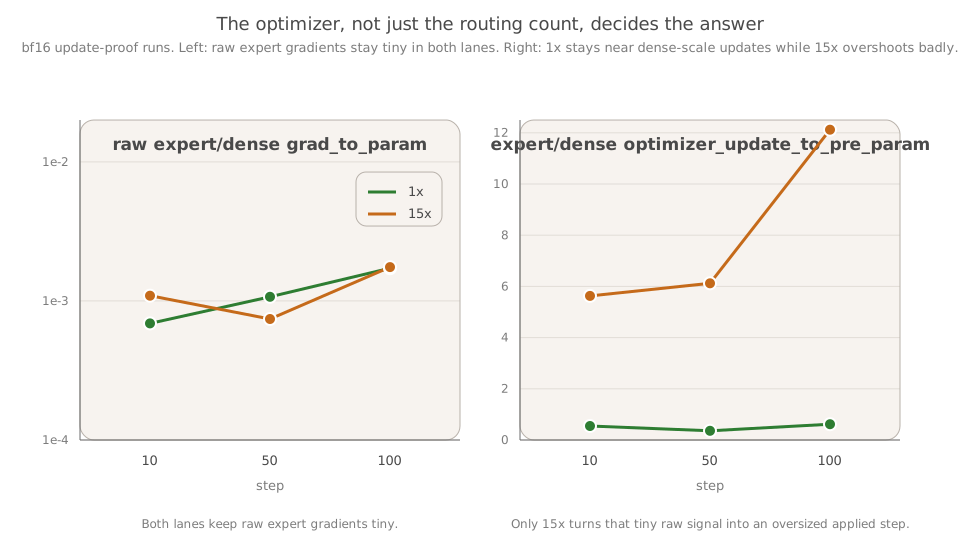
1x and 15x. The applied-update story changes completely. The right baseline is set by the preconditioned step, with routing counts only supplying the tiny raw signal.The measured pattern matches the derivation.
NVFP4 / ExpertAdamW diagnostic
The current nvfp4 / ExpertAdamW evidence is diagnostic only. It is single-seed and only compares 1x to 15x, so it shows direction and mechanism but does not close the Moonlet nvfp4 tuning question. Within that narrower scope, the lane differs mostly in degree.
| Multiplier | Seed | Steps | Final loss | Stop reason |
|---|---|---|---|---|
1x | 42 | 200 | 7.9618 | completed |
15x | 42 | 200 | 8.1885 | completed |
Unlike bf16, 15x does not collapse in the first 200 steps. It still loses to 1x by the end of the window, and the update ratios show why.
| Multiplier | Step | expert/dense grad_to_param | expert/dense optimizer_update_to_pre_param |
|---|---|---|---|
1x | 10 | 9.67e-4 | 0.531 |
1x | 50 | 7.98e-4 | 0.283 |
1x | 100 | 3.06e-3 | 0.217 |
1x | 200 | 2.63e-3 | 0.338 |
15x | 10 | 8.38e-4 | 5.42 |
15x | 50 | 3.91e-4 | 3.91 |
15x | 100 | 2.48e-3 | 3.81 |
15x | 200 | 4.45e-3 | 6.10 |
So nvfp4 sits closer to the boundary than bf16. At 1x, expert updates are still smaller than dense updates by a larger margin than in bf16, yet they stay within dense-scale magnitudes. At 15x, expert updates again overshoot dense. The right reading is that more attenuation survives the adaptive optimizer in nvfp4 / ExpertAdamW than in bf16 / AdamW, while 15x still overcorrects for Moonlet.
NVFP4 grad-health canary
We also ran a short 50-step nvfp4 canary with the new per-expert grad-health tags (zero_frac, abs_mean, abs_max). Treat it as extra diagnostic evidence on the expert gradient field.
| Multiplier | Step | Final loss | w1 zero frac | w2 zero frac | w3 zero frac |
|---|---|---|---|---|---|
1x | 50 | 9.5620 | 0.71% | 0.71% | 0.71% |
15x | 50 | 9.4193 | 13.35% | 13.35% | 13.35% |
Treat this as a warning canary. The 15x lane can grab a small early loss edge while making the expert gradient field much harsher and much sparser. By 200 steps, that edge is gone and 1x is better.
The answer
Here is the scoped answer. Moonlet carried a loud opinion about this question, and on the settled bf16 lane that opinion is wrong. Experts do not need a larger learning rate than the dense path. 15x already overshoots, and 0.5x is not better than 1x. The clean earned setting there is lr_expert = lr_dense.
The reason is that sparse routing attenuates raw expert gradients, but the adaptive optimizer cancels much of that attenuation before the step is applied. The broader lesson is regime-dependent: you have to ask how much of the sparse-routing attenuation survives the optimizer before you start multiplying expert LR by hand. On the current evidence, bf16 / AdamW is the settled proof lane, while the short nvfp4 / ExpertAdamW results point in the same direction without closing the full tuning question.
What this does not say
This is not a universal MoE expert-LR law.
It does not settle:
- non-adaptive controls such as SGD, where the derivation predicts a different answer
ExpertMuonor other adaptive families with materially different update dynamics- the full
nvfp4optimum, which still needs a wider sweep and longer-horizon repeats
The paper earns a narrower result than that, and a stronger one: on Moonlet bf16 with AdamW, the old 15x rule is wrong for mechanistic reasons we can now measure.
Receipts
Receipt bundle: nmoe/repro/0008.receipts.json
# bf16 main sweep
bash scripts/repro/run_0008_bf16_sweep.sh blog_artifacts/0008_expert_lr_bf16_20260311
python3 scripts/repro/summarize_0008_bf16_sweep.py --kind main --study-root blog_artifacts/0008_expert_lr_bf16_20260311

# bf16 update-proof
bash scripts/repro/run_0008_bf16_updateproof.sh blog_artifacts/0008_expert_lr_bf16_updateproof_20260311
python3 scripts/repro/summarize_0008_bf16_sweep.py --kind updateproof --study-root blog_artifacts/0008_expert_lr_bf16_updateproof_20260311 --steps 10,50,100,130,200

# nvfp4 diagnostics
bash scripts/repro/run_0008_nvfp4_updateproof.sh blog_artifacts/0008_expert_lr_nvfp4_updateproof_b20260311
python3 scripts/repro/summarize_0008_bf16_sweep.py --kind nvfp4_updateproof --study-root blog_artifacts/0008_expert_lr_nvfp4_updateproof_b20260311 --steps 10,50,100,130,200
bash scripts/repro/run_0008_nvfp4_gradhealth.sh blog_artifacts/0008_expert_lr_nvfp4_gradhealth_c20260311
python3 scripts/repro/summarize_0008_bf16_sweep.py --kind nvfp4_gradhealth --study-root blog_artifacts/0008_expert_lr_nvfp4_gradhealth_c20260311 --steps 10,50

# verify receipts
python3 scripts/repro/verify_post_receipts.py --repo-root . --receipts-dir repro --post 0008
References
Key references for this post are Shazeer et al., "Outrageously Large Neural Networks: The Sparsely-Gated Mixture-of-Experts Layer" (2017); William Fedus, Barret Zoph, and Noam Shazeer, "Switch Transformers: Scaling to Trillion Parameter Models with Simple and Efficient Sparsity" (2021); Diederik P. Kingma and Jimmy Ba, "Adam: A Method for Stochastic Optimization" (2015); and Ilya Loshchilov and Frank Hutter, "Decoupled Weight Decay Regularization" (2019).