
What Are We Holding Fixed?
Dense-vs-MoE comparison depends on the fairness contract; a failed `#420` transfer exposed the real problem
Dense training lets us pretend that model size has one face. Sparse training does not. The moment we move from dense FFNs to experts, model size splits in two: there is the model we store, and there is the smaller model any one token can actually touch. Most dense-vs-MoE arguments quietly choose one of those objects and call it fairness.
0004 exists because we did that too.
We started by trying to transfer Karpathy's #420 loop as literally as we could. The instinct was good. A token-indexed horizon, fixed-fraction checkpoints, and one public family slice are exactly the sort of disciplined contract that prevents research from dissolving into vibes. But the first transfer taught us something more important than the result it produced. It taught us that, in MoE work, the choice of fairness contract is itself part of the experiment.
So the real subject of this post is not whether one small sparse family beat another. It is a simpler and more dangerous question:
when we compare dense training to expert sparsity, what exactly are we holding fixed?
1. The Useful Failure
The first transfer was deliberately conservative. We kept the dense #420 shape as intact as we could: token-indexed horizons, fraction-of-horizon checkpoints, and one published family slice under totalDN = 8.
For the published slice, that produced the following headline rows at 20% of horizon.
| Family | Depth | Routed Experts | Tokens at 20% | bpb | CORE |
|---|---|---|---|---|---|
d10 | 10 | 64 | 759M | 1.40 | +0.001 |
d12 | 12 | 256 | 4.5B | 1.21 | +0.065 |
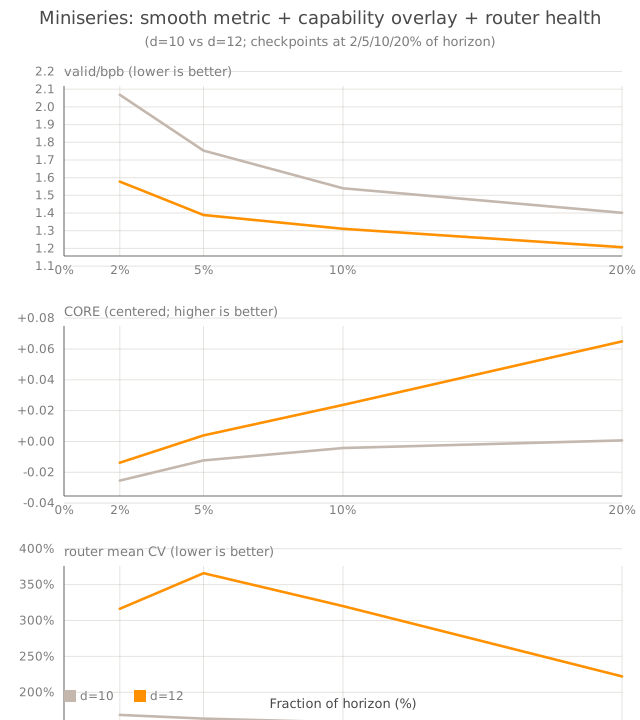
d12 separated on both bpb and CORE. It also changed more than one dial. The deeper model stored more experts and consumed a much larger token budget under the totalDN horizon.That slice was useful precisely because it was honest. It told us two true things at once.
First, a dense-style #420 loop really does transfer to MoE in one limited sense. Token-indexed horizons and fraction-of-horizon checkpoints produce a legible family slice instead of the usual step-count chaos.
Second, a legible slice is not automatically a fair one. In this transfer, depth changed, routed expert count changed, and horizon changed with total stored parameters. The local result may have been interpretable, but the causal dial was not.
That failure is the reason this paper exists.
2. Model Size Splits In Two
The right way to say the problem mathematically is that MoE gives us at least two natural parameter objects.
Let P_total(m) be the total number of trainable parameters in model m. That is the dense notion of model size: everything the model stores, whether a token uses it or not.
Let P_active(m) be the parameter mass a token can actually touch. In nmoe, the canonical definition is the one encoded in nmoe.metrics.param_counts:
with
Here H is width, E routed experts, K activated experts, S shared experts, D_ff^moe expert FFN width, and L_moe the number of MoE layers.
For dense models, these two objects collapse: P_total = P_active. For MoE they do not. Stored capacity and active capacity diverge by design.
That gives us two equally natural horizon contracts:
| Contract | What is held fixed | What question it answers |
|---|---|---|
totalDN | tokens per stored parameter | How much data does the whole stored model get? |
activeDN | tokens per active parameter | How much data does the per-token computation actually get? |
Neither contract is silly. They simply answer different questions. Dense training hides that distinction because the two objects coincide. Sparse training forces us to choose.
There is one more local fairness axis worth keeping explicit. In 0003 we matched active FFN width per token:
- dense:
W_active = inter_dim = 3072 MoE-64:W_active = (K + shared) * moe_inter_dim = 8 x 384 = 3072MoE-256:W_active = (K + shared) * moe_inter_dim = 8 x 384 = 3072
That matters. It kills one easy confound. It does not settle the global fairness question, because equal active FFN width per token does not imply equal P_total or equal P_active over the whole model.
3. The Active-Like Side Is Already Real
The good news is that one half of the fairness story is already closed.
The completed 0003 closure matrix kept dense, MoE-64, and MoE-256 on the same 9536-step, 4.9996B-token June-style speedrun family. Once we compute the exact parameter objects, that turns out to be an almost-perfect active-parameter comparison.
| Model | P_total | P_active | tokens / P_total at 9536 | tokens / P_active at 9536 |
|---|---|---|---|---|
| Dense | 190,532,352 | 190,532,352 | 26.24 | 26.24 |
MoE-64 | 755,534,592 | 191,073,024 | 6.62 | 26.17 |
MoE-256 | 2,836,482,816 | 192,891,648 | 1.76 | 25.92 |
Those active-parameter ratios are close enough that the existing 0003 matrix already behaves like the activeDN side of the comparison. The total-parameter ratios are nowhere near equal, so the same matrix is decisively not a totalDN result.
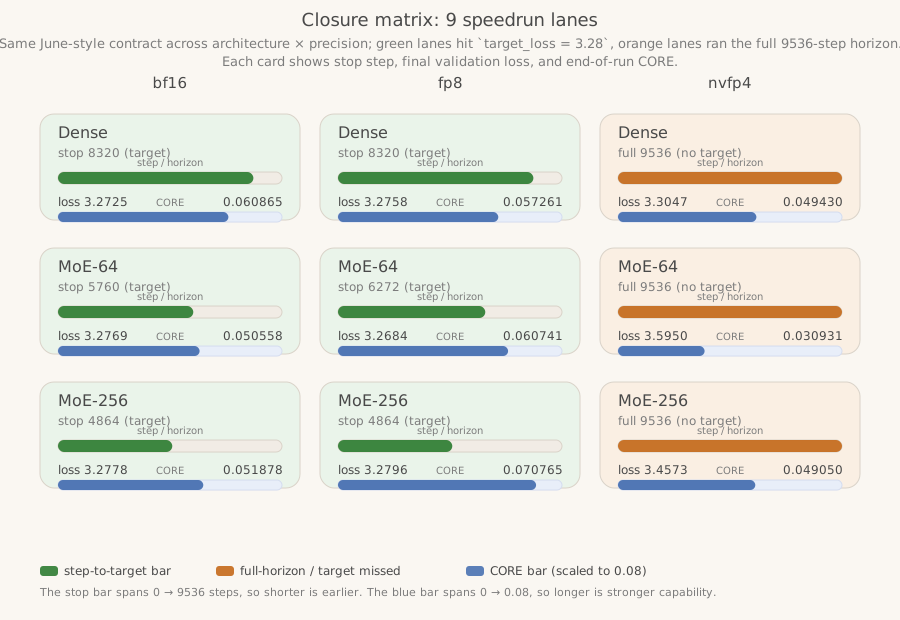
0003 closes the matched active-parameter side of the story. The three models saw almost the same tokens per active parameter, even though sparse storage grew dramatically across the family. Precision matters too, but the nvfp4 story belongs to 0005.If we set the precision pathology aside for the moment and look only at the bf16 and fp8 lanes, the active-like record says this:
| Dtype | Dense | MoE-64 | MoE-256 | Main read under the active-like contract |
|---|---|---|---|---|
bf16 | target at 8320, CORE = 0.060865 | target at 5760, CORE = 0.050558 | target at 4864, CORE = 0.051878 | sparse reaches the loss target sooner, but dense still keeps the best CORE |
fp8 | target at 8320, CORE = 0.057261 | target at 6272, CORE = 0.060741 | target at 4864, CORE = 0.070765 | MoE-256 wins both on stop step and on CORE |
That is already a substantive result. Under an almost-equal active-parameter horizon and a matched active-width swap axis, expert sparsity is not a toy effect. It clearly changes the answer.
But it is still only one contract.
4. The Stage-1 totalDN Answer
The strongest version of this paper is still the statement
for at least part of the dense-vs-MoE family.
That is the real claim worth earning. If the ranking changes when the horizon contract changes, then fairness is not bookkeeping. It is the result.
If we preserve the dense-derived coefficient from 0003,
then the full totalDN horizons are:
| Model | full totalDN steps |
|---|---|
| Dense | 9536 |
MoE-64 | 37813 |
MoE-256 | 141963 |
Those full horizons are too expensive for a same-day publish pass, so the first closure pass uses the same 20% fraction that made the original d10 / d12 slice readable at all. Dense needs no new training because P_total = P_active there and the dense curve is already fixed. The new work is sparse.
| Model | stage-1 totalDN20 steps | final valid loss | CORE | Main read |
|---|---|---|---|---|
| Dense | existing curve reused | --- | --- | the dense baseline is already fixed; the stage-1 new work is sparse |
MoE-64 | 7563 | 3.2625 | 0.051871 | reaches the old speedrun target, but only modestly changes the active-like picture |
MoE-256 | 28393 | 2.8554 | 0.145743 | pulls away sharply once stored capacity gets token budget proportional to what the model stores |
The important part is not just the endpoint. Once the contract changes, the schedule changes with it. That means target-hit step alone is not enough. The right comparison surface is fixed fractions of each contract, plus CORE.
The stage-1 table already decides the first thing we needed to know. The sparse ordering does not flip under totalDN; it becomes much stronger. Under the active-like bf16 contract, MoE-64 and MoE-256 are both fast-to-target sparse wins with similar end-of-run CORE. Under the staged totalDN contract, MoE-256 keeps training for much longer, ends far lower on loss, and posts a dramatically stronger capability score than MoE-64.
5. What The Stage-1 Table Already Says
The honest state of the paper now looks like this.
| Contract | Dense | MoE-64 | MoE-256 | What the contract says |
|---|---|---|---|---|
active-like (0003, bf16) | stop 8320, CORE = 0.060865 | stop 5760, CORE = 0.050558 | stop 4864, CORE = 0.051878 | sparse reaches the loss target sooner, but dense still keeps the best CORE |
active-like (0003, fp8) | stop 8320, CORE = 0.057261 | stop 6272, CORE = 0.060741 | stop 4864, CORE = 0.070765 | MoE-256 wins both on stop step and on CORE |
totalDN20 (0004, bf16) | dense curve already fixed; no new rerun in this stage | 7563, 3.2625, CORE = 0.051871 | 28393, 2.8554, CORE = 0.145743 | the sparse ordering survives and the margin widens dramatically once horizon follows stored capacity |
That is already enough to change the interpretation. The active-like contract asks what happens when per-token computation gets equal data. The staged totalDN contract asks what happens when stored capacity gets equal data. On this family, those two questions do not tell the same story.
6. Current Answer
Here is the answer that stands today.
- A dense-style
#420loop does transfer to MoE in one important sense: token-indexed horizons and fraction-of-horizon schedules produce interpretable slices. - The first literal transfer was valuable because it failed honestly. It exposed that depth, sparsity, and token budget were entangled.
0003closes the matched active-parameter side of the fairness question for dense versusMoE-64versusMoE-256.- The completed
totalDN20sparse pair shows that the larger sparse model keeps its lead and widens it sharply once stored capacity gets a proportionate token budget.
So the lasting claim of 0004 is still simple: in MoE research, dense-vs-sparse comparison is incomplete until the chosen contract is named. The new result is that even a staged totalDN probe already changes the scientific picture materially.
Limitations
- The published
totalDNresult is a staged20%closure pass; the full37813/141963-step horizons remain future work. - Dense at the same fixed fraction is read from the existing dense curve rather than rerun as a separate stage-1 campaign.
- The motivating
d10/d12slice remains structurally confounded and should be read as a useful failed transfer rather than a scaling law. - The
0003closure matrix still closes only the matched active-parameter side of the fairness comparison. - Precision-dependent pathologies, especially the
nvfp4lanes, are real but belong in0005.
Receipts
- Fairness-question receipts:
nmoe/repro/0004.receipts.json - Active-like closure receipts:
nmoe/repro/0003.receipts.json - Canonical total-vs-active parameter definition:
nmoe/metrics.py - Verify the receipt bundles from the repo root:
python3 scripts/repro/verify_post_receipts.py --repo-root . --receipts-dir repro --post 0004
python3 scripts/repro/verify_post_receipts.py --repo-root . --receipts-dir repro --post 0003
References
- Karpathy,
#420dense-scaling methodology and dense+Muon comparison loop. 0003. The Speedrun Loop.0005. NVFP4 Dynamics.