
Make It Measurable
What to track when loss isn't enough
Post 0002: what I track for MoE (
bpb+CORE+ router health), and why “loss went down” is not a sufficient stopping condition.
Loss is a good training metric right up until it is not.
With dense models, I can usually get away with watching the loss curve and using capability evals as a slower, noisier overlay. With MoE, that stopped being enough. I had runs where loss kept improving while the router was clearly converging to something pathological. I had eval setups that looked fine until distributed execution made them deadlock or lie.
That is what forced this measurement stack.
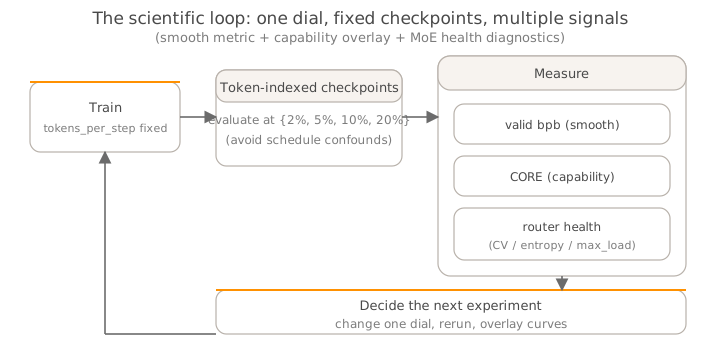
I want one smooth compression curve, one noisy capability curve, and one set of router-health canaries. If those disagree, the disagreement is the result.
Receipts for this post live in nmoe/repro/0002.receipts.json. They cover the exported healthy-vs-collapsed router comparison, the three-panel bpb/CORE/router-health slice, the miniseries CORE summary used for the task-bootstrap variance check, and the distributed lockstep failure contract. Broader multi-seed grids and larger galleries move to later posts.
The Problem With Loss
For dense models, loss is usually enough to tell me whether training is moving in the right direction. If it goes down, I am probably learning. Capability is noisier, but it tends to move in the same direction.
MoE breaks this. Loss can go down while the router converges to a clearly pathological state. You still get a pretty curve. You also end up training a smaller model wearing a larger model's coat.
So every MoE run now gets three views: a smooth compression metric for learning progress, a capability read for whether the model is becoming more useful, and router-health signals for whether the sparse system is behaving at all.
A concrete failure case
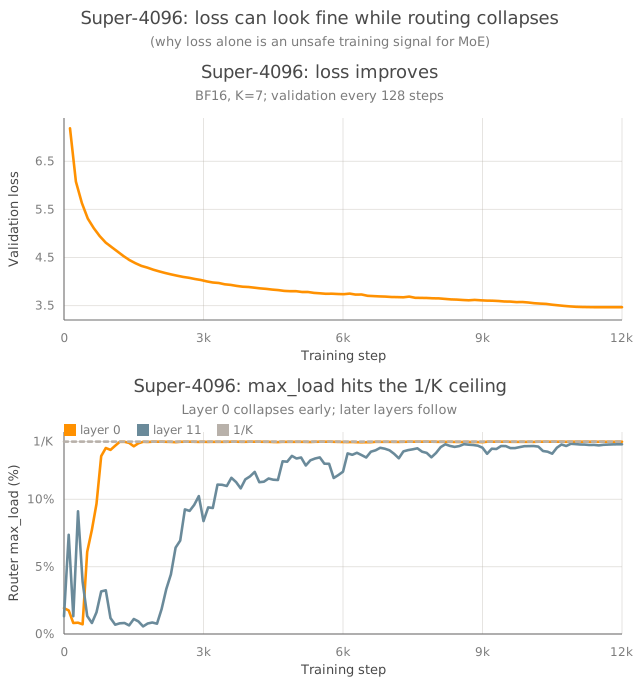
This is the simplest reason “watch the loss” fails for MoE: the optimizer can keep making progress even as the router collapses into a much narrower effective expert system.
In a Super-4096 run (4096 routed experts, top-7 routing), validation loss keeps improving smoothly while the router's max_load rapidly saturates to the theoretical ceiling of about 100/K %—equivalently 1/K in fraction units, meaning one expert appears in almost every token's top-k.
What I Actually Track
| Signal | Primary tags/artifacts | Unit | Source | Why it exists |
|---|---|---|---|---|
| compression | valid/loss, valid/bpb, valid/tokens, valid/bytes | nats/token, bits/byte | nmoe/metrics.py, nmoe/token_bytes.py | smooth optimization progress, tokenizer-agnostic comparison |
| capability | eval/CORE, eval/core/<task>/centered, core_summary.json | centered accuracy | nmoe/eval/core/runner.py | task-level capability movement above random baselines |
| router balance | router_agg/mean_cv, router_agg/min_entropy, router/layer_XX/max_load | CV%, nats, max_load% | nmoe/metrics.py | detect collapse hidden by loss curves |
| per-layer health | router/layer_XX/{cv,entropy,experts_active,bias_range} | mixed | nmoe/metrics.py | localize failure modes to specific layers |
| throughput/runtime | throughput/*, efficiency/*, gpu_* | tokens/s, ms, utilization | nmoe/metrics.py | separate optimization quality from systems bottlenecks |
Bits-Per-Byte: The Smooth Signal
Cross-entropy loss is tokenizer-dependent. A model with 32k vocab and a model with 200k vocab report different losses for the same underlying compression quality. That makes it hard to compare across papers, across tokenizers, and even across your own experiments if you change tokenization.
Bits-per-byte (bpb) fixes that. It measures how many bits you need to encode each byte of the original text:
A model with bpb = 0.7 needs 0.7 bits to encode each byte of the original text. That number means the same thing regardless of tokenizer.
We compute bpb on a fixed validation set—same data, same order, every time. That gives us a smooth curve that tracks learning progress without the noise of capability benchmarks.
Bpb data contract and sanity check
For bpb checkpoints we log the following tags:
| Tag | Meaning |
|---|---|
valid/loss | mean NLL in nats/token under the validation-loss mask |
valid/tokens | evaluated token count under the validation-loss mask |
valid/bytes | decoded byte count for the bpb path; EOS is excluded here |
valid/bpb | canonical bpb tag from the dedicated bpb loss accumulator |
Important current-code nuance: valid/bpb is the canonical compression tag. In the current public trainer, the bpb path always excludes EOS, while valid/loss and valid/tokens only exclude EOS when loss_mask_eos=true. That means valid/loss * valid/tokens / (valid/bytes * ln(2)) is only an exact recompute when those masks match.
Sanity query—exact when the validation-loss mask and the bpb mask match, for example loss_mask_eos=true:
WITH t AS (
  SELECT
    step,
    max(CASE WHEN tag='valid/loss' THEN value END) AS loss,
    max(CASE WHEN tag='valid/tokens' THEN value END) AS tokens,
    max(CASE WHEN tag='valid/bytes' THEN value END) AS bytes,
    max(CASE WHEN tag='valid/bpb' THEN value END) AS bpb
  FROM read_parquet('<metrics_dir>/<run_id>/step_*.parquet', union_by_name=true)
  WHERE tag IN ('valid/loss','valid/tokens','valid/bytes','valid/bpb')
  GROUP BY step
)
SELECT
  step,
  bpb,
  loss * tokens / (bytes * ln(2)) AS bpb_recomputed,
  abs(bpb - loss * tokens / (bytes * ln(2))) AS abs_err
FROM t
WHERE bpb IS NOT NULL
ORDER BY step;
For the current miniseries receipts, treat the exported valid/bpb tag as canonical. If we want unconditional public recomputability from logged tags alone, we should also log the bpb-specific loss sum or force the two masks to match. Older run layouts may store metrics in rank_0.duckdb; the same masking caveat applies there.
CORE: The Capability Signal
Validation loss tells you the model is compressing better. It says very little about question answering, instruction following, or code reasoning.
For that, we use CORE (Capability-Oriented Evaluation): a suite of multiple-choice benchmarks built from tasks such as MMLU, ARC, HellaSwag, and WinoGrande. The model sees a question with a small set of options, and we ask whether it assigns the highest probability to the correct one.
The trick is centered scoring. Raw accuracy is misleading because random baselines differ. MMLU has 4 choices, so chance is 25%. WinoGrande has 2 choices, so chance is 50%. A model scoring 35% on MMLU is doing better than one scoring 55% on WinoGrande, even though the raw number is lower.
Centered scoring fixes this:
The simplest example is a two-task comparison:
| Task | Choices | Baseline | Accuracy | Centered |
|---|---|---|---|---|
| A | 2 | 0.50 | 0.60 | 0.20 |
| B | 4 | 0.25 | 0.40 | 0.20 |
Raw accuracy says 60% > 40%. Centered scoring says both performances land the same distance above random. That is the quantity I actually care about. Once you center every task this way, you can average across tasks and get a single capability number that means something.
CORE is noisier than bpb; benchmark variance is real. What it gives you is a read on competence beyond raw compression.
To get a feel for that noise, I bootstrap the task-level centered scores from the miniseries CORE summary exported in this post's receipts (22 CORE tasks per checkpoint):
| Checkpoint | CORE | Bootstrap 95% CI |
|---|---|---|
step 863 | -0.0138 | [-0.081, 0.031] |
step 2156 | +0.0039 | [-0.071, 0.053] |
step 4312 | +0.0237 | [-0.025, 0.059] |
step 8624 | +0.0649 | [+0.024, +0.112] |
delta 863 -> 8624 | +0.0787 | [+0.031, +0.137] |
Takeaway: the long-span improvement across this slice is detectable, but individual checkpoints still carry wide uncertainty bands. Small intermediate deltas are easy to over-read unless you add more tasks or repeat seeds.
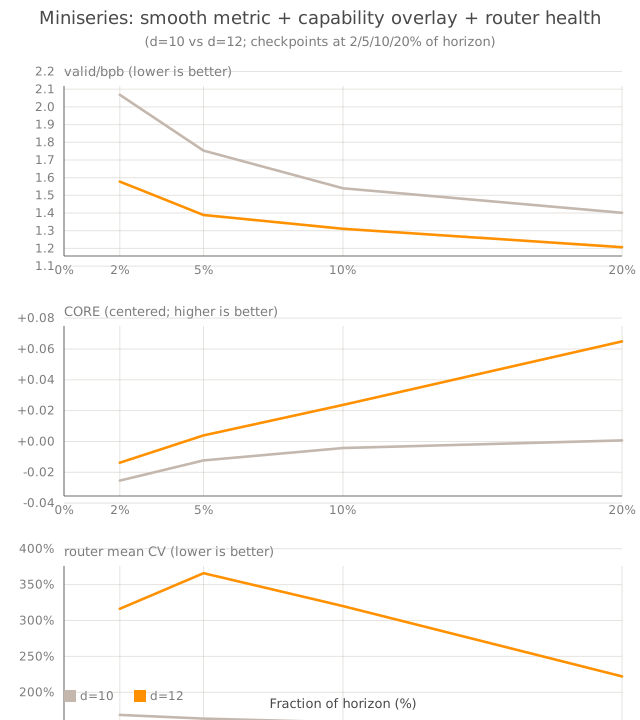
bpb is the smooth physics curve. CORE is the capability overlay. Router health is the MoE sanity check that tells you whether the curve means what you think it means.Router Health: The MoE-Specific Sanity Checks
This is where MoE diverges from dense. You need to watch the routing itself, because unhealthy routing can hide behind good loss.
A quick note on units: some pre-nmoe prototypes reported normalized router metrics, for example CV as a decimal or entropy normalized to [0,1]. In nmoe, we log CV% and entropy in nats, and only derive normalized views later for intuition.
Load balance (CV)
The coefficient of variation measures how unevenly tokens are distributed across experts:
In nmoe we log CV as a percentage, so CV = 87% means std = 0.87 x mean.
In healthy routing, CV stays bounded. Experts get roughly comparable traffic. When CV explodes into the thousands of percent, you have entered the regime where a few experts get almost everything.
Entropy
Entropy measures routing diversity. We log raw Shannon entropy, in nats, of the per-expert load distribution:
I usually read it three ways. The maximum is log(E). H_norm = H / log(E) puts you back on a [0,1] scale, where 1.0 means uniform routing. E_eff = exp(H) gives the effective expert count—how many experts you are really using.
Max load
nmoe logs max_load as the percentage of routed assignments going to the single most popular expert. Divide by 100 to get the corresponding fraction. In an E-expert model with uniform routing, that fraction would be 1/E.
For top-K routing there is an even sharper signature: if one expert appears in almost every token's top-K, max_load will asymptote to approximately
When max_load pins to 1/K across layers and stays there, you are no longer seeing healthy broad utilization. You are seeing a dominant-expert attractor.
Dead experts and min entropy
Dead experts count how many experts received zero routed assignments in a step, aggregated across layers. A few dead experts can happen at small per-expert batch. Persistent mass death means you are training a smaller effective model than you think.
Mean entropy can also look healthy while one layer quietly collapses. That is why I track router_agg/min_entropy as a canary. It catches the layer that is going bad before the mean admits anything is wrong.
What Healthy Looks Like
Here is what the metrics look like for a healthy MoE-64 run versus the collapsed Super-4096:
| Metric | MoE-64 bf16 (healthy) | Super-4096 (collapsed) |
|---|---|---|
| Final loss | 3.43 | 3.47 |
| mean CV% | 87% | 1733% |
| mean entropy | 3.91 nats | 4.15 nats |
| min entropy | 3.77 nats | 2.25 nats |
E_eff at min entropy (exp(H_min)) | ~44 experts | ~9 experts |
L0 max_load | 16.6% (1/K for K=6) | 14.3% (1/K for K=7) |
The loss looks similar. The router health does not. MoE-64 is using most of its capacity. Super-4096 keeps a high mean entropy, but its worst layer drops to about 9 effective experts while CV and max_load both scream collapse.
MoE-64's L0 sits at 1/K, but only that one layer does. The rest of the network stays healthy. In corrected-stack Super-4096, many layers eventually pin there, but the onset is depth-nonuniform rather than simultaneous. 0006 covers that progression layer by layer.
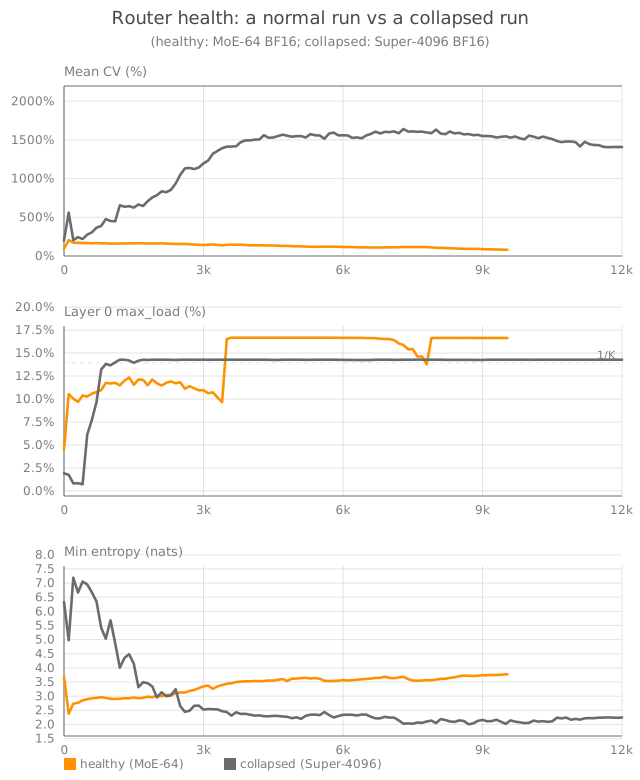
CV and high entropy. The collapsed run explodes to 1700% CV and pins max_load at 1/K.This is why I track router health alongside loss. You cannot see the difference from the loss curve alone.
Where These Numbers Come From
nmoe writes metrics as per-step parquet under <metrics_dir>/{run_id}/step_XXXXXXXX.parquet from a DuckDB-backed in-memory writer.
| Scope | Tags |
|---|---|
| per-layer | router/layer_XX/{cv,entropy,max_load,experts_active,bias_range} |
| aggregates | router_agg/{mean_cv,std_cv,mean_entropy,min_entropy,dead_experts_count,experts_active_mean} |
The implementation is short enough to show directly:
# nmoe/metrics.py (simplified)
l = ffn.last_loads.detach().float()  # per-expert assignment mass for this MoE layer
m = l.mean()
cv = (l.std(unbiased=False) / m * 100.0).item()  # CV%
mx = (l.max() * 100.0).item()                   # max_load%
p = (l / l.sum().clamp_min(1e-9)).clamp_min(1e-12)
entropy = (-p * p.log()).sum().item()           # nats
A query pattern I use constantly:
-- mean CV over time
SELECT step, value
FROM read_parquet('<metrics_dir>/<run_id>/step_*.parquet', union_by_name=true)
WHERE tag = 'router_agg/mean_cv'
ORDER BY step;

-- per-layer max_load at one step
SELECT tag, value
FROM read_parquet('<metrics_dir>/<run_id>/step_00009536.parquet', union_by_name=true)
WHERE tag LIKE 'router/layer_%/max_load'
ORDER BY tag;
We keep the public posts free of internal run ids, but internally this is still how I move from story to receipts.
Healthy depends on the regime (E, K, batch, horizon), but the same invariants keep showing up: all experts stay active at reasonable batch sizes, CV stays bounded, entropy stays high, and max_load does not pin to 1/K across layers. When one of those breaks, I start looking for a hidden hot subnetwork.
The same views reappear later in the series: 0003 uses them in the speedruns, 0004 overlays them on the miniseries curves, and 0006 uses them to show collapse propagating layer by layer.
The Engineering Gotcha
There is a subtlety with MoE eval that took me longer than it should have to make fully explicit.
Under expert parallelism, the model is distributed across GPUs. When you forward a batch, the router on GPU 0 might send tokens to an expert on GPU 3. If GPU 3 is doing something else, like evaluating a different prompt, you deadlock.
That means evaluation has to run in lockstep: all GPUs process the same prompts at the same time. You cannot shard the eval dataset across GPUs the way you would for dense models.
Once you see the problem, the fix is simple. Everyone evaluates the same prompts in lockstep, and rank 0 accumulates the centered results. It is less efficient than sharding, but it is correct, and correctness is the whole point.
Wrong path for distributed MoE CORE—the one that deadlocked or invalidated eval in earlier iterations:
torchrun --nproc_per_node=8 -m nmoe.eval.core.runner \
  --snapshot <metrics_dir>/eval/<run_id>/step_0000863/eval_snapshot.pt \
  --tasks-file configs/eval/core.toml
Current fail-loud guard:
RuntimeError: CORE snapshot eval is not supported for MoE under distributed execution (world_size=8). Run eval_tasks=core with eval_mode=inline (live lockstep), or evaluate the snapshot with world_size=1.
That message exists for a reason. The alternative is a hang or, worse, an eval that returns numbers that do not correspond to a real distributed forward.
The broader eval tree still has other snapshot-oriented runners. The narrower claim here is about the distributed MoE CORE contract: for that case, the correct path is live lockstep CORE on the in-memory sharded model (nmoe.eval.core.runner.run_core_live via training integration).
Receipts for this post are in nmoe/repro/0002.receipts.json.
Post 0003 is where we used this stack to calibrate the setup against a known-good dense baseline before trusting new MoE results.